A new game is loading…
Stay tuned for the release of PlaySafe Louisiana!
PlaySafe Louisiana
Can you spot an online predator?
“PlaySafe Louisiana” is an interactive game that puts youth in realistic gaming scenarios to stay safe online. In less than 15 minutes, players will learn to recognize common online predator tactics and how to respond if something feels unsafe. Complete all 10 lessons to earn a printable Online Safety Certificate!
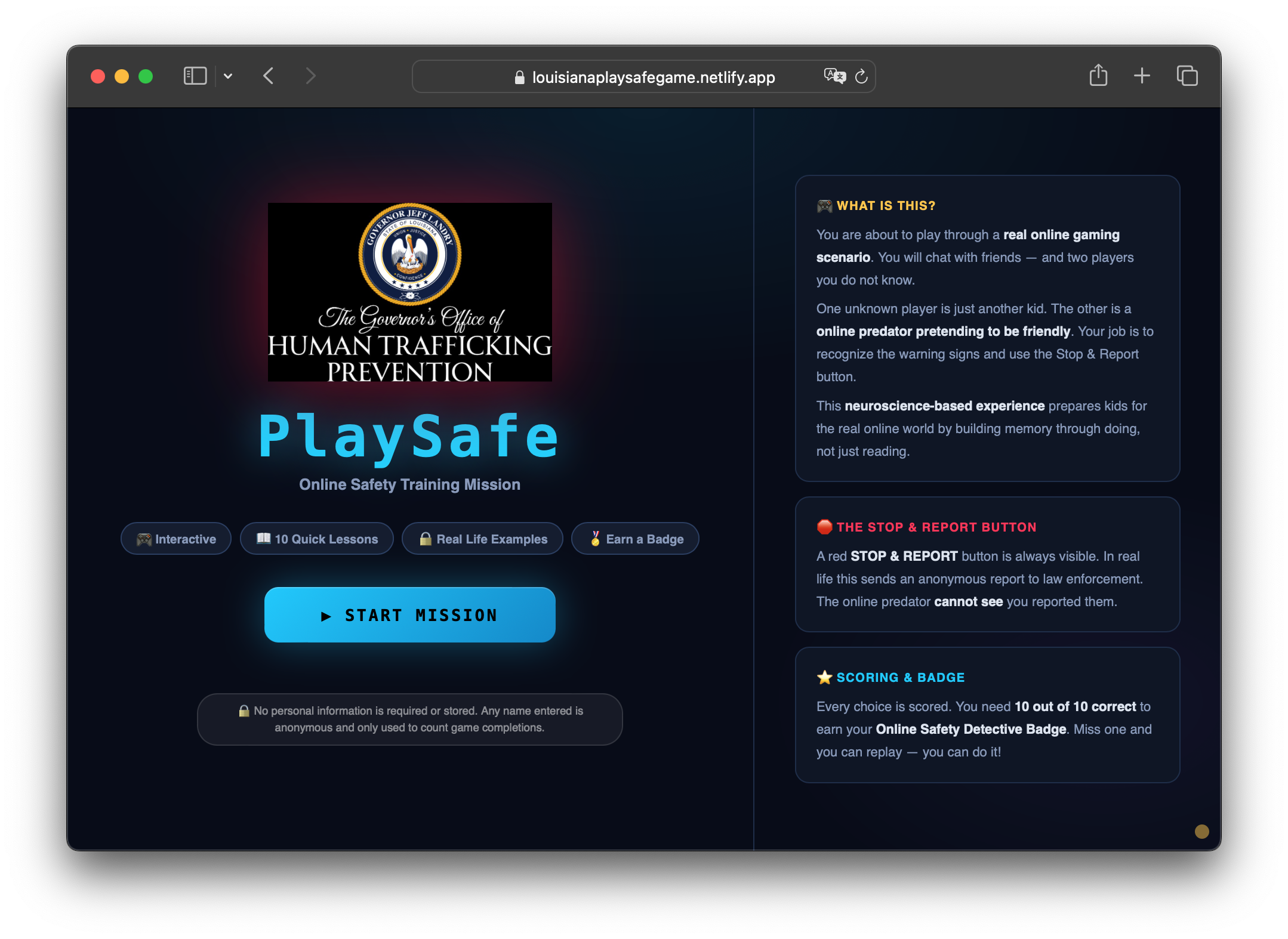
10 Quick Lessons
Real scenarios kids face everyday in online gaming and social media.
Neuroscience-Based
Learning through experience to build stronger memory
Stop & Report Practice
Practice using an online report button – just like in a real game.
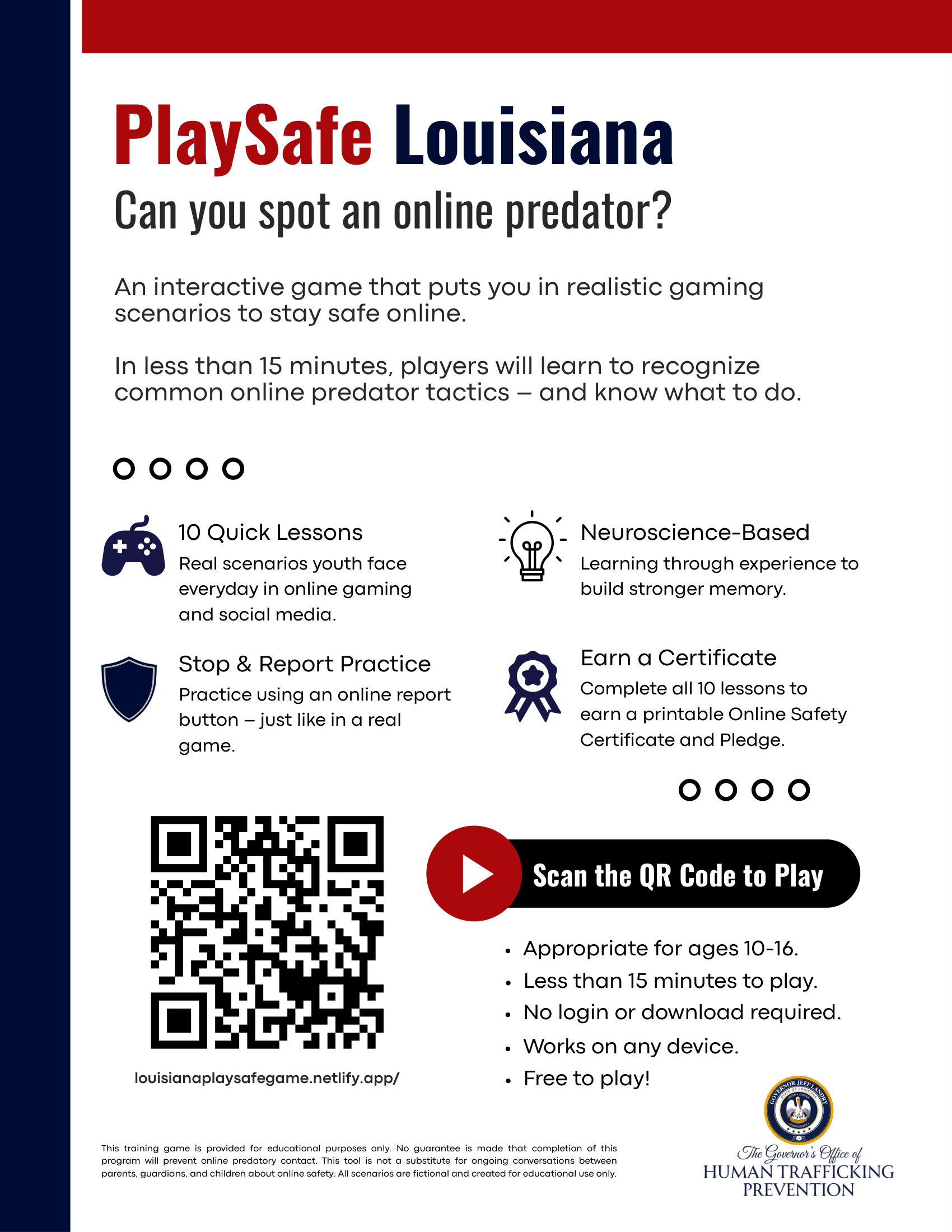
Share PlaySafe with Others
Download and print the PlaySafe Louisiana Flyer to share with youth and parents in your community.
- Youth ages 10–16
- Parents and Guardians
- Schools and after school programs
- Youth organizations
- Law enforcement and child safety advocates
- Community workshops
Post-Game Impact Survey
Provide your feedback at lapostplaysafegamesurvey.netlify.app.
Frequently Asked Questions
-
Who should play the game?
The game is best suited for children and youth ages 10–16 years old. Parents, school personnel, coaches, or mentors are encouraged to play the game first before sharing it with their youth. Be prepared to answer follow-up questions that the youth may have about staying safe online!
-
How do I play the game?
- Click here to play the game. You can play the game on a desktop or on a mobile phone.
- Enter your first name and state (Louisiana). If you choose to remain anonymous, type in “anonymous” (or the name of your favorite movie or book character) in the name blank.
- Click “Start Mission” to begin.
- Read the chat and make choices in each chapter.
- Get 10 out of 10 to earn your online safety detective badge.
- Take the Pledge.
- Print your Badge and Pledge Certificate.
-
What are the lessons from the game?
Players will learn to recognize 10 common online predator tactics:
- Asking personal questions about the youth’s age or where they go to school.
- Offering gifts to the youth.
- Asking the youth to move the conversation to a private chat.
- Asking the youth to keep their conversations and connection hidden from friends or family.
- Asking whether the youth is home alone or unsupervised.
- Sending unexpected or inappropriate images to the youth to normalize inappropriate content or sexual conversations.
- Asking the youth to send private photos.
- Repeatedly attempting to contact the youth after being blocked.
- Asking for the youth’s account password or passcode.
- Asking where the youth lives or suggesting that they meet in person.
Most importantly, a player will learn what to do next – report, screenshot, and tell a trusted adult!
-
Is the game free?
Yes, the game is free!
-
Do I need to create an account?
No, you do not need to create an account or provide any identifying information to play the game.
-
What information do you collect?
The game does not collect any personal data from you. While you will be prompted to input your name and state before the game begins, you can provide your first name only or choose to be “anonymous.”
-
Who developed the game?
The game is a product of Not on Our Watch Texas. Through a licensing agreement with Not on Our Watch Texas, the Louisiana Office of Human Trafficking Prevention is pleased to host the game as a key prevention education resource for Louisiana.
-
Can I share the game or incorporate it into my education and outreach materials?
Yes, please share this game with your community! You can download and print the flyer linked above. We also encourage public leaders, youth organizations, law enforcement, and child safety advocates to incorporate information about PlaySafe into their educational or outreach efforts. For questions, please email [email protected].
-
Can I provide feedback to improve the game?
Yes, we encourage that you complete the linked survey to provide input and feedback about the game to the Office of Human Trafficking Prevention and Not on Our Watch TX.
-
What should I do if a child or youth confides in me about abuse or exploitation?
If a child or youth shares information with you about abuse or exploitation, you should:
- Listen without judgment and validate their feelings. Reinforce that you believe them and that it is not their fault.
- Be clear with the youth about what will happen next, including your duty to report.
- Make a report to law enforcement or the Department of Children and Family Services (DCFS) Child Abuse Hotline at 855-452-5437. Mandatory reporters can learn more about their reporting obligations at dcfs.louisiana.gov/mandated-reporters.
- If the abuse involves online sexual exploitation of a child (including sharing child sexual abuse material or unwanted sexual messages to a child), you may report also to the the Cyber Tipline at report.cybertip.org.
- Address the child or youth’s immediate safety needs and provide follow-up support. You can locate a list of victim service providers in your area by visiting the Services Map.
-
How do I remove explicit photos of myself (or my child) from the internet?
If you believe that explicit photos of you (or your child) have been shared online, you can make a report to Take It Down. Take It Down is a free service that can help you remove or stop the online sharing of nude, partially nude, or sexually explicit images or videos taken of children and youth under the age of 18. You can submit a request online at takeitdown.ncmec.org.
If there is an explicit image of you online from when you were 18 or older, you can get help at protectprivacy.ai.
If a platform has failed to remove your images, visit takeitdown.ftc.gov to make a report.
Disclaimer: The PlaySafe game is a product of Not on Our Watch Texas (NOW), licensed by the Office of the Governor, Office of Human Trafficking Prevention. This training game is provided for educational purposes only. No guarantee is made that completion of this program will prevent online predatory contact. This tool is not a substitute for ongoing conversations between parents, guardians, and children about online safety. NOW is not responsible for individual outcomes. All scenarios are fictional and created for educational use only.